New UX/UI for Toaster Platform
Role
Product Designer
Company
Toaster
Timeline
October 2022
Team
3 Designers + 4 Engineers

Key Takeaways 🏆
This redesign of Bitpanda’s onboarding experience led to a significant reduction in drop-off rates, a smoother user journey, and improved first-time investment conversion. By identifying friction points, simplifying key steps, and improving clarity, we helped more users successfully complete their onboarding. This case study details how research, iterative design, and strategic optimizations led to these results.
Problem
We have adopted building fast with AI. However, designers know this puts a spotlight on the speed <> quality dilema.
Knowing speed wasn't negotiable in an engineering led-company, my goal was to achieve the highest quality AI output possible. With Claude Code in the codebase, Figma through MCP, Claude design and other tools for prototyping on the side, we had good bases to build a good workflow.
However, our design system didn't have enough context for the LLMs to know how to behave around them.
Context
Toaster is an internal tool developed by Phiture to enhance keyword optimization (KWO) in App Store Optimization (ASO). The product was initially created to automate and streamline the KWO process for Phiture’s consultants.
The tool's evolution focused on addressing the needs of ASO, the growing power of AI and ensuring its robustness for large-scale data handling.
Short-Term Goals
Improve user adoption
Streamline the KWO process.
Long-Term Goals
Enhance scalability
Integrate advanced analytics and AI features
Expand localization support
Launch as B2B SaaS.

Objectives
Reduce manual work
Manual keyword optimization process was a major bottleneck.
Automation and AI integration
Ensuring a good starting point to further improve the platform, integrating external data bases and AI to minimize the users effort.
Scalability
Making the tool robust enough to handle large-scale keyword benchmarks in all categories within the App Stores.
Research
User Interviews
Understand workflows, challenges, and needs.
Competitive Analysis
Analyzed other tools to identify best practices and areas for improvement.
Test Prototypes
Evaluated our ideas and solutions to validate our hypothesis and gather direct feedback.
Add error
messages
Team member
The navigation menu is cluttered.
Team member
Add
share link
Team member
Speed optimization is needed.
Sometimes we have too much data on the pages.
Team member
Some place to link documentation related to each client
Team member
Doesn't work with tiled windows
Team member
Accept excel
and google sheets
Team member
Cant access my user profile easily
Team member
Would love to customize my dashboard to show my preferred metrics
Team member
Information Architecture

Design
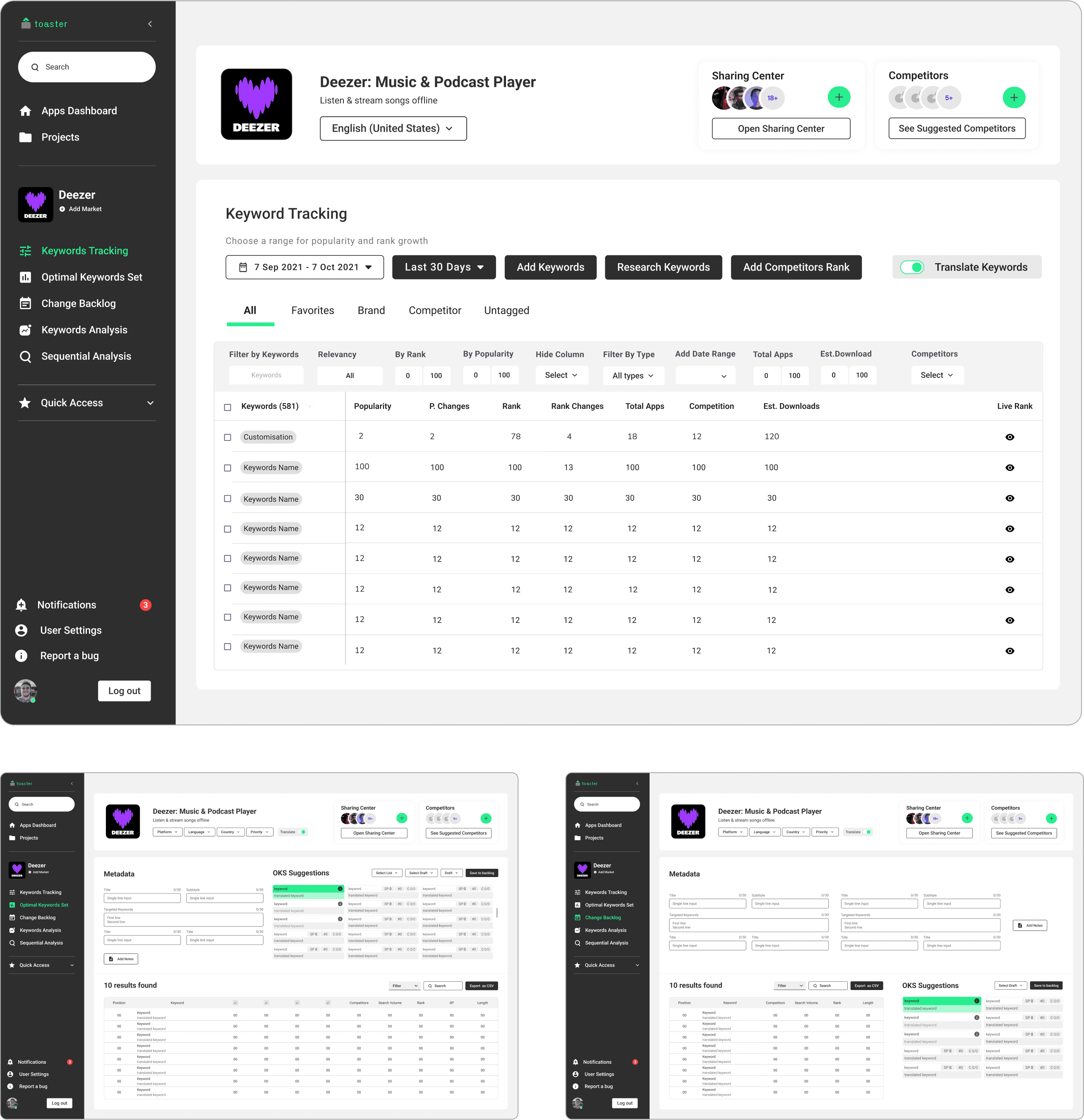
Old screens of the product

Updated platform after re-design

What didn’t go as planned
Billable work <> Internal work
Being Toaster an internal platform, it meant we all had to juggle our billable projects with the Toaster sprints. This brought some communications gaps regarding correctly setting the expectations and managing other priorities.
Initial Over-Reliance on Automation
Some features prioritized automation over user control, leading to suboptimal user satisfaction in case of the need of manual input.
BONUS TRACK
Redesign of the UI Library
In this context, our task was clear: document the Guidelines and build a Design System that worked swiftly and efficiently, setting the foundation for future scalability.
1. Audit of existing Design Elements
2. Prioritization of Critical Components
3. Collaborative Feedback Loops
4. Documentation and Guidelines
5. Future Optimization


